
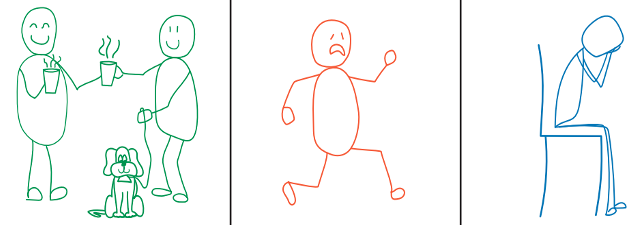
It was the first time I’d heard anyone talk about the nervous system in relation to dating when my relationships coach told me that mine was getting in the way of me finding a stable, loving partner – and it made a lot of sense.
Because when I looked at my patterns, I could see that a lot of what I was experiencing was down to how my body was responding – and that it had a huge influence over my feelings and my behaviour, including who I was choosing.
I wanted something steady and healthy, but I usually felt drawn to something quite different.
And my natural optimism often dipped into complete hopelessness when it came to the relationship I wanted.
If you can relate, there’s a good chance your nervous system is playing a bigger role in your dating than you realise.
Here are five ways it might be shaping how you date.
1. You feel a strong spark and you say a big “yes”
You meet someone and there’s an instant pull. Strong chemistry. A buzzy, excited feeling. And you get the sense that this connection means something big – or at least that’s your initial interpretation.
For me, these kinds of connections were utterly compelling. I loved the excitement and the high of them – and I interpreted the strength of my feelings as a sign of how wonderful and romantic the relationship was going to be.
But it was usually a very different story in reality – the strong feelings were more often than not a sign that my nervous system’s fight-flight response was activated by the dynamic, because it was making my body feel stressed or unsafe.
It would’ve been more helpful to see a strong pull as an amber flag – a warning sign that the high I was feeling might not be the good thing I thought it was.
And that it was a good idea to get to know this person slowly, instead of riding the big wave of excitement and diving right in.
Because my system often wasn’t drawn to the stability and safety I wanted, it was defaulting to what was familiar to me – our nervous systems are wired to seek out what’s most familiar in an attempt to keep us safe, but this can often do the opposite.
2. Stable men usually seem boring or unattractive
You meet someone who’s calm, consistent, emotionally available – and there’s just nothing much there. No spark. No pull. Sometimes even boredom, or plain lack of interest.
For me, the people who were more steady or available just didn’t register as exciting. I’d feel neutral at best, staring into the space where the spark should be.
I might have found some of those men attractive if it weren’t for my nervous system associating activation with attraction, and calm with disinterest.
I overlooked the very people who could make suitable partners. Time and time again, I thought: “He seems like a wonderful person, but how can I start a relationship with someone I’m not attracted to?”
It was a fair point – but one I made when I didn’t realise how much of a role my nervous system played in who I was attracted to – and that it could change.
3. The relationship you want feels impossible
I spent years feeling and believing that the kind of relationship I wanted just wasn’t available to me. It felt like something that only happened for other people, and so much of the time I felt sure I’d always be alone.
Especially each time an emotionally intense connection turned into disappointment – that’s when my nervous system went into shut-down (freeze) to try and protect me from overwhelming feelings, and getting hurt again.
When we feel safe and connected, there’s naturally more sense of possibility and optimism – and the deeper we go into a survival response, the more our optimism drops.
And when that happens, even imagining being in a loving relationship can feel out of reach.
4. Dating feels like a waste of time
When it all feels impossible, dating can easily start to feel like a waste of time.
There were periods where I just didn’t have the energy for it – it felt draining because even though I was showing up, I wasn’t getting anywhere.
I often stopped altogether, because trying just made me feel even more hopeless.
When we’re in a survival state, our social engagement system – the part of us that connects us with others – switches off, because the body is prioritising survival over connection.
So it makes sense that you’d have less motivation to date – and you literally have less capacity to connect with potential partners.
And this creates a cycle of feeling less open, which leads to less connection, and even more hopeless about dating.
5. You’re up for dating and the relationship you want feels totally possible
This can happen more easily when life feels relatively settled, you feel generally supported and connected (in your community of friends, for example), or there’s less emotional intensity in general.
You feel a sense of openness, and it seems like the relationship you want could actually be possible, or even probable.
It doesn’t mean you feel excited about everyone – but you feel more open to more people. Dating doesn’t feel like something you’re pushing through, it feels like something you have the energy to engage with and can enjoy.
Because your nervous system is in the safe and connected state – not survival mode – your social engagement system is switched on, and your optimism and sense of possibility is alive and well.
What I’ve come to understand – through personal experience and practice, my work with clients and everything I’ve studied around the nervous system – is that it plays a huge part in how we turn up (or not) in dating, the choices we make, and how a situation feels – depending on whether we’re in survival mode or in a more safe and connected state.
Experiences like intense chemistry, lack of interest, hopelessness, or a sense of possibility are all subject to change, depending on what’s happening in our nervous system.
None of it means you’re doing anything wrong. It just means your system is responding in the way it’s learned to, based on past experiences, and the ways it tries to protect you.
When we acknowledge that, it’s easier to relate to our patterns with more understanding and less self-judgement.
And to consciously look for ways to bring more of a sense of safety and connection to our system, more of the time – something that helped me a lot in moving towards my own stable, committed relationship with more confidence, more ease, and more enjoyment in the process.
If you found this helpful, you might also like my free audio 3 Game-Changing Keys to Attract Your Committed Dream Partner – Even When It Feels Impossible. Click Here to Download It.
It’s designed to help you start shifting old dating and relationship patterns, attract an emotionally available, committed partner – and move confidently toward a healthy, happy, secure relationship.

More blogs
What’s Self-Love Got To Do With It? My Wedding at Age 47
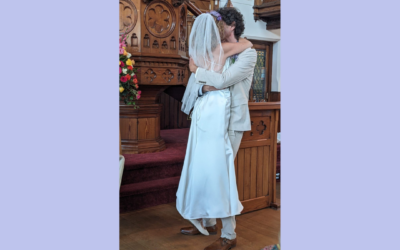
I just got married to someone wonderful, who's consistently available, loving and deeply kind (and quite a bit taller than me as you can tell by my feet!), which still feels like something of a miracle to me - because I can honestly say that there were many times when...

Healthy Boundaries in Long-Term Relationship
The first blog in this series - Healthy Boundaries in Dating - looks at why healthy personal boundaries are essential for meeting a suitable partner. The second blog - Healthy Boundaries in Early Relationship - explores why we need a healthy Yes and No as we begin to...
Healthy Boundaries in Early Relationship
The first blog in this series - Healthy Boundaries in Dating - looks at how essential boundaries are when you're open to meeting a suitable partner. What we say “Yes” to and what we say “No” to in life does, after all, shape our experience. This blog explores why you...
I've always wanted to make the lifelong commitment of partnership in marriage, and it's been a very long journey for me to get to my wedding day at age 47. I spent a lot of my adult life in painful patterns when it came to romantic relationship, which included being attracted to those who weren't really available, and not able, for their own reasons - and I say this without any blame - to meet and love me in all the ways I wanted to be met and loved. And I wasn't willing to settle for a relationship that wasn't truly right for me.
It has taken a lot of determination, courage and persistence to overcome and heal the obstacles within me that got in the way of experiencing the relationship I wanted, and indeed to become the kind partner that I would myself want to commit to.
I could write a whole book about the process (maybe one day I will), but for now I'll just say that the most important aspect of it has been (and always will be) my commitment to Love in my primary relationship - my relationship with myself.
Love with a capital "L" is unconditional - it can't be fallen out of. So even when I fall out of "like" with myself, it's always in the greater context of my commitment to loving myself, which means I always come back to the recognition that I am unconditionally loveable and worthy of love.
We all know that Self-Love can be a real challenge. It requires commitment to doing what it takes to have a truly healthy relationship with ourselves - an ongoing deepening of self-awareness, attunement and kind responsiveness to our needs and feelings, being open to seeing things about ourselves that are hard to look at and own, and learning to embrace parts of us that we feel the impulse to push away and disconnect from.
But it is so incredibly worth it - and the alternative certainly isn't a recipe for happiness - because self-love, or the lack of it, sets the tone - and determines the quality - of all of our relationships. Whilst I'm loving and embracing myself, I can't not be loving my husband... I can't not be loving everyone (which definitely includes setting healthy boundaries, and sometimes walking away, of course).
Even when I don't like parts of them. Even when there's conflict and it's painful. My commitment to Love guides me back home to my deepest self and invites me to do the work I need to do to meet the other with Love - whether it's learning to communicate more clearly and kindly, listening openly to feedback, or soothing and holding the vulnerable parts of myself more fully and compassionately when there's reactivity in our relating, to name a few examples.
Whether I'm coaching an individual or a couple around their relationships, I see that the most important part of my job is to keep inviting folk back to their relationship with themselves. That's always what needs kind and loving tending to first, whatever is happening in their relationships with others.
Which is why I'm so passionate about supporting people with self-love, and with making it practical - so it's more than just an idea, or yet another thing to have to achieve or "get right".
If you’re interested in finding out more about the coaching and workshops I offer, please do get in touch at info@nicola-madden.com
Ps. I am definitely not saying "you have to love yourself before anyone else can love you". This is a very unhelpful idea! And simply not true.